How does automatic video distribution work in DashClip Delivery?
Sending a video to multiple channels sounds simple at first. But as soon as several channels are interested in the same type of content, one important question arises:
Who gets the video first – and what happens if that channel doesn't use it?
This is exactly what the automatic distribution system in DashClip Delivery is designed to solve.
Instead of offering a clip to every selected channel at the same time, DashClip Delivery processes the pool of channels selected by the submitter. This creates a fairer distribution process while ensuring that a video isn't immediately lost just because one channel decides not to download it.
Watch the process
If you prefer a visual explanation, the complete workflow is also explained in this video:
https://www.youtube.com/watch?v=AaC218-5BcY
The submitter chooses the channel pool
When submitting a video, the submitter decides which channels should be eligible to receive the clip.
DashClip Delivery does not randomly distribute submitted videos to every channel connected to the platform.
Instead, each submission receives its own pool consisting exclusively of the channels selected by the submitter.
For example:
- Channel A
- Channel B
- Channel C
- Channel D
Only these channels participate in the distribution process for that particular video.
Why not offer the video to everyone at once?
Technically, a video could simply be offered to every selected channel simultaneously.
However, that would create an obvious problem: several channels would effectively compete for the same content. In many cases, the winner would simply be whichever channel happens to be online and clicks the download button first.
DashClip Delivery takes a different approach.
A video is initially offered to one channel.
That channel gets the opportunity to decide whether it wants the video without having to compete with every other selected channel at the same time.
Round-robin distribution
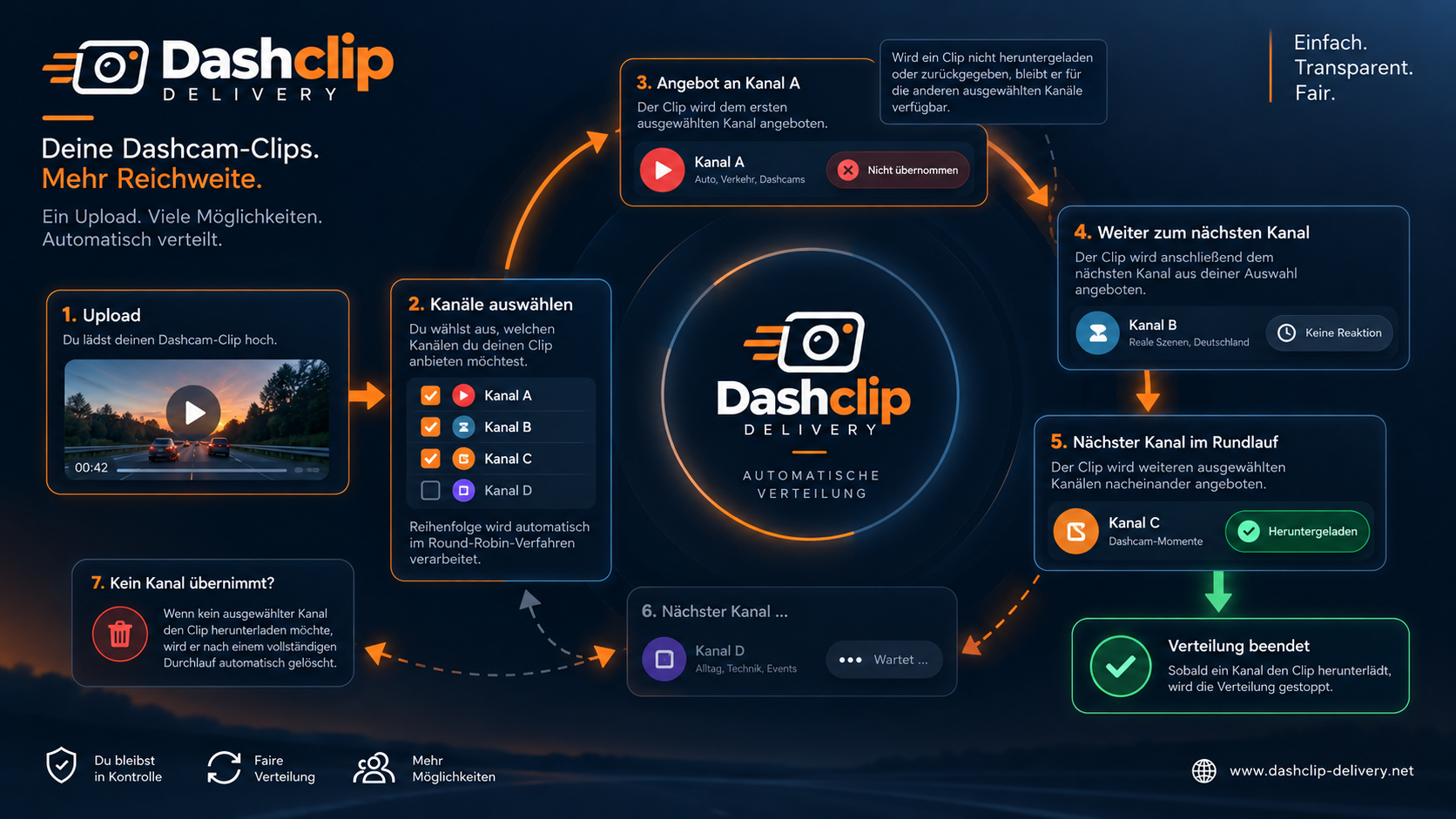
Videos move through the pool of channels selected by the submitter using a rotating distribution process.
In simplified form:
Channel A → Channel B → Channel C → Channel D → End
The channel that receives a particular submission first depends on the distribution logic. This helps prevent the same channel from permanently receiving preferential treatment.
The diagram illustrates the basic principle: a video moves through its selected channel pool until the distribution has either been completed successfully or every eligible channel has been considered.
What happens if a channel doesn't download the video?
Receiving an offer does not mean that a channel is required to use the video.
A channel may decide that a particular clip doesn't fit its content. An offer may also expire without the video being downloaded.
In that case, the clip is not lost.
It remains available to the other channels originally selected by the submitter.
During the next applicable distribution cycle, the video can therefore be offered to another channel from the remaining pool.
For example:
Channel A receives the video → no download
Then:
Channel B receives the video → no download
Then:
Channel C receives the video → download
Once Channel C downloads the video, distribution of that clip is complete.
Channel D will therefore no longer receive it.
What happens when a video is returned?
A channel can also return a video that has already been offered to it.
From the perspective of the distribution process, the result is similar:
The video returns to the remaining distribution process.
An initial assignment therefore doesn't necessarily mean the end of a submission. As long as other selected channels remain eligible, DashClip Delivery can continue distributing the video.
The submitter doesn't have to upload the clip again or manually contact another channel.
When does distribution end?
There are essentially two possible endpoints for a submitted video.
1. A channel downloads the video
The objective of the distribution has been reached and the process ends.
2. Every eligible channel has been considered
If none of the selected channels downloads the video and the clip has completed its journey through the eligible channel pool, distribution also ends.
A video therefore isn't endlessly circulated between the same channels.
One upload instead of multiple individual submissions
The main benefit isn't just the underlying distribution algorithm.
For submitters, the entire process can be reduced to a single submission:
Upload the video → select the desired channels → submit.
From that point onward, DashClip Delivery handles the distribution process.
If one channel doesn't use the video, the submitter doesn't have to manually find another suitable channel, complete another submission form and upload the same files again.
At the same time, participating channels aren't simply flooded with every submission simultaneously. Instead, they receive the offers intended for them as part of the distribution process.
Fair for submitters and channels
The goal of DashClip Delivery isn't to distribute as many copies of the same video as possible.
Instead, the platform is designed to create a structured connection between submitters and content channels.
Submitters can select multiple channels they are interested in without having to submit the same clip several times.
Channels can accept or return videos without automatically eliminating the submitter's opportunity to have the clip considered by the other selected channels.
One upload. Multiple potential channels. One automated and fair distribution process.
That's the basic idea behind DashClip Delivery.