
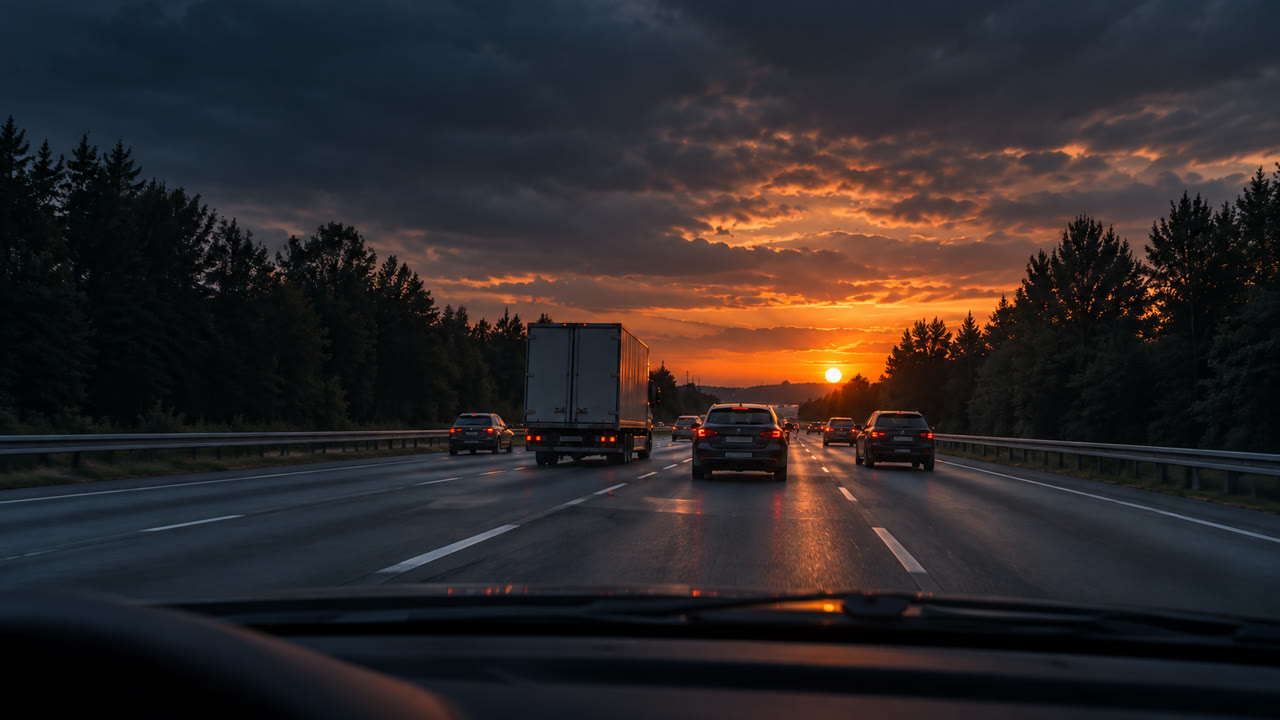
A collision rarely lasts longer than three seconds. What follows often drags on for months: accounts that contradict each other, an assessment, a split of liability nobody is happy with. This is exactly where a dashcam comes in. It offers no opinion, only a section of what happened.
One account against another
The most common dispute after a crash is not bad faith, it is an honest gap in memory. Under shock people take in only parts of a situation, and afterwards they fill the gaps unconsciously with whatever seems plausible. Two people can therefore describe entirely different sequences without either of them lying.
Without witnesses there is little left to work with. Marks on the road allow some conclusions, but not many. A recording, by contrast, shows the order of events: who braked first, whether anyone indicated, how quickly the gap closed.
What footage actually achieves
In a liability case following a road accident, the German Federal Court of Justice held that dashcam footage can be used as evidence, even though permanently recording without cause is not permissible under data protection law. What decides the question is a balancing exercise in the individual case, in which the interest in functioning legal proceedings carries considerable weight. The details are in the press release of the court.
That means two things for you. Footage can noticeably change the outcome of a dispute. And it does not release you from running your camera sparingly. What that looks like in practice is covered in the article on dashcams and data protection.
Warning
This article gives general orientation and is not legal advice. For a specific case, a lawyer is the right address.
Beyond the crash
Not every useful recording comes from an impact. A stone chip on the motorway, deer crossing at dawn, a vehicle shooting out of a driveway without anything actually happening: these are scenes that cannot be repeated and that nobody can reconstruct afterwards.
Such recordings carry value beyond your own case. Sharing them makes typical hazards visible, and other drivers recognise situations they know from their own routes. That is exactly why channels covering road traffic exist, and exactly where DashClip Delivery fits in.
Keeping the limits in mind
A camera is not a shield. It prevents no collision, it settles no claim by itself, and it only ever shows the section its lens captures. Anyone relying on footage to clear everything up will occasionally be disappointed.
Realistically, a dashcam is a tool that makes the difference in a few important moments. For it to manage that, it has to be mounted properly, deliver usable images and keep the decisive file when it counts. Those are the points the next articles in dashcam knowledge work through.